Data Logging and Automation for Degumming Line Optimization
Modern edible oil refining is no longer won only by chemistry. It is won by repeatability.
For refineries using enzymatic degumming, the difference between a strong run and a frustrating one often sits in the operating history: feed variability, temperature drift, water addition, acid contact, residence time, mixing intensity, centrifuge load, soap carryover, and phosphorus trend movement before the oil reaches downstream neutralization or physical refining.
Clarivane supplies enzyme solutions for edible oil degumming, but enzyme performance depends on the process window around it. That is why data logging and automation matter. A well-instrumented degumming line gives refinery teams the evidence needed to stabilize phosphorus reduction, reduce neutral oil loss, protect uptime, and scale from trial to routine production with fewer surprises.
Why automation matters in enzymatic degumming
Enzymatic degumming is process-sensitive. The enzyme can support strong phosphorus reduction and improved oil recovery, but the line has to deliver controlled conditions.
Automation helps refinery managers answer practical questions:
- Was the oil at the right temperature when enzyme was introduced?
- Did the acid and water additions stay proportional to real feed flow?
- Did the mixer deliver enough contact without creating unnecessary emulsion stress?
- Did holding time remain stable during feed rate changes?
- Did centrifuge differential pressure, discharge pattern, or sludge phase behavior change during the run?
- Did final phosphorus movement match the expected operating conditions?
When these variables are logged instead of remembered, troubleshooting becomes faster and more commercial. The discussion shifts from opinions to trend lines.
The core data points worth logging
A degumming data system does not need to be complicated to be useful. The highest-value signals are usually the ones closest to dosing control, reaction stability, and separation behavior.
Feed and flow stability
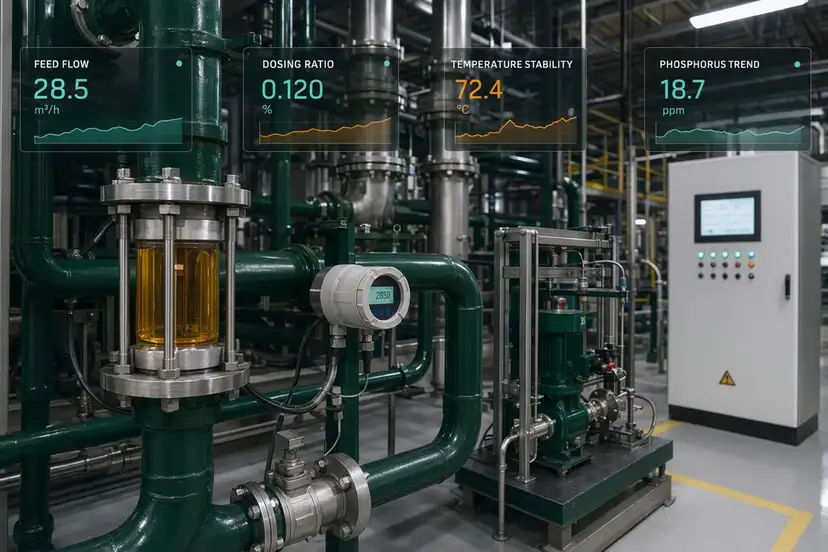
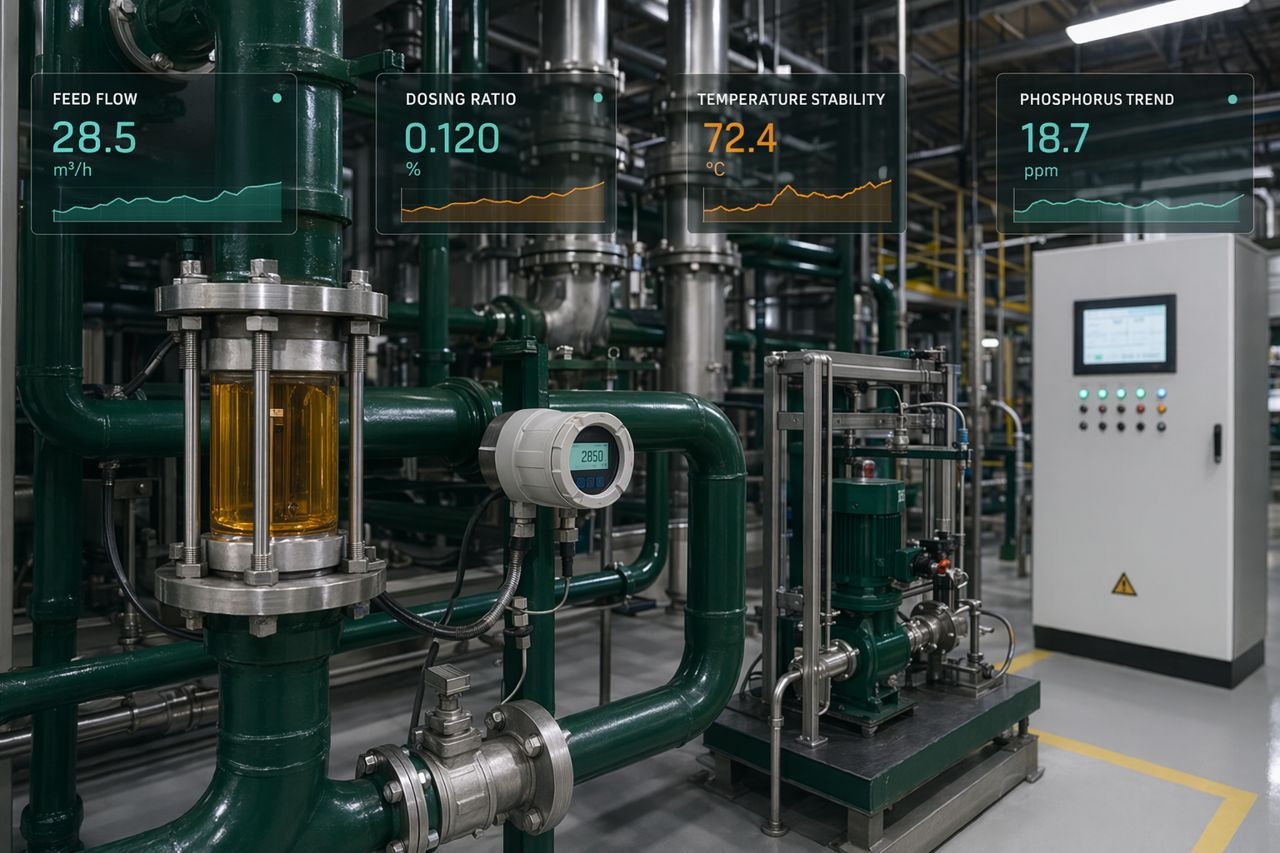
Log crude or water-degummed oil flow rate continuously. Enzyme, acid, water, and caustic-related additions should be evaluated against actual flow, not assumed nameplate throughput.
Feed interruptions, recirculation, or rate reductions can change contact time and dosing ratio. If the historian captures these events, the refinery team can separate genuine enzyme response from hydraulic instability.
Temperature profile
Temperature should be recorded at key points, including before acid conditioning, before enzyme addition, through the reaction zone, and before centrifugation.
Small drifts can influence viscosity, mixing, reaction consistency, and centrifuge phase split. Logged temperature profiles help identify whether phosphorus excursions are chemistry-related or caused by thermal instability.
Acid, water, and enzyme dosing
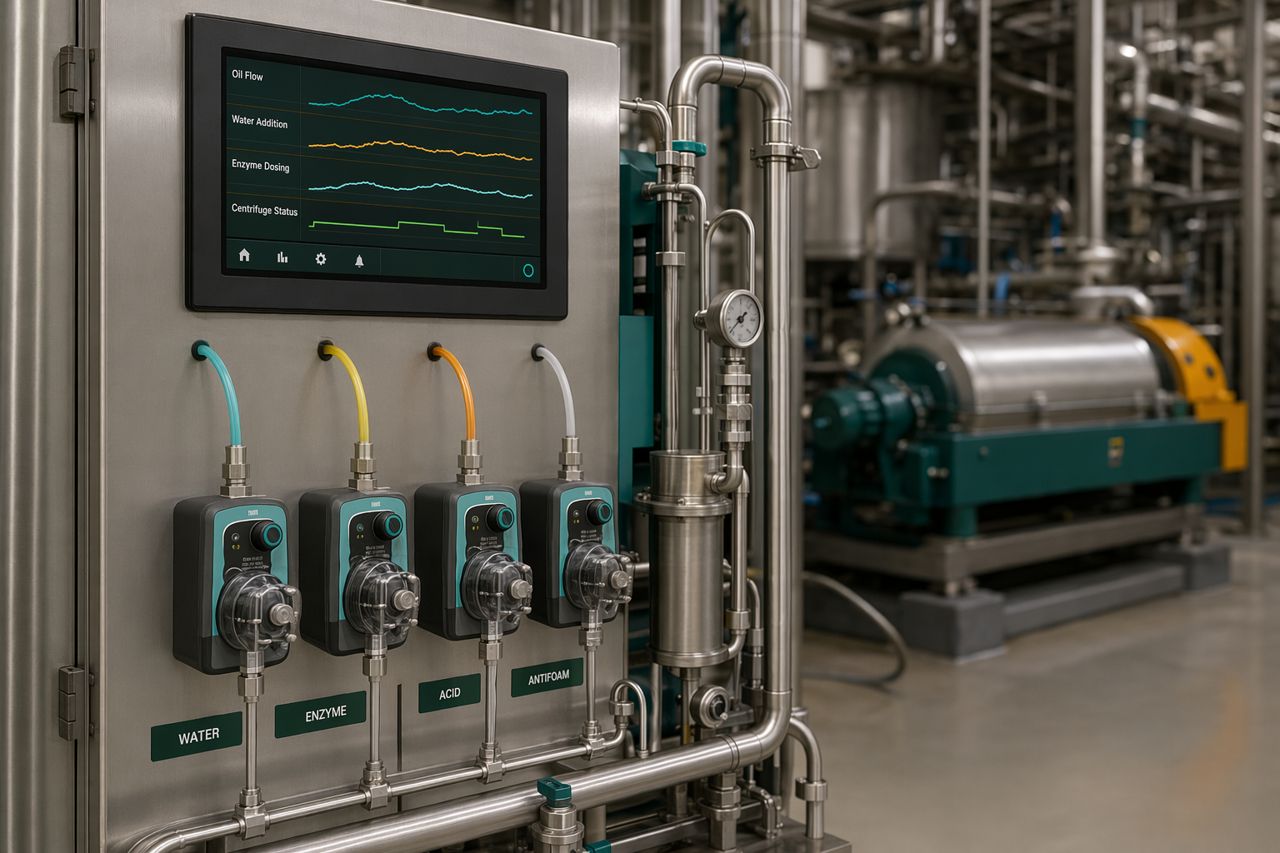
For enzymatic degumming, dosing consistency is central. Flowmeter readings, pump speed, valve position, tank level, and interlock status should be trended together.
A good automation setup makes it easier to confirm that additions were delivered when feed was moving, at the intended ratio, and under stable mixing conditions.
Mixing and residence time
Enzymatic degumming relies on contact. Log mixer status, speed where available, pressure drop across static mixers, tank levels, transfer pump status, and hold-tube or retention-tank residence indicators.
Residence time variation is one of the most common hidden causes of uneven results. If throughput rises but hold volume stays fixed, reaction time falls. A historian makes that visible.
Centrifuge behavior
The centrifuge is often where process quality becomes obvious. Useful logged signals include:
- Feed rate into the centrifuge
- Bowl load or motor load
- Differential pressure or backpressure
- Discharge timing
- Heavy phase flow or sludge trend where measured
- Oil outlet clarity indicators where available
- Interface control behavior
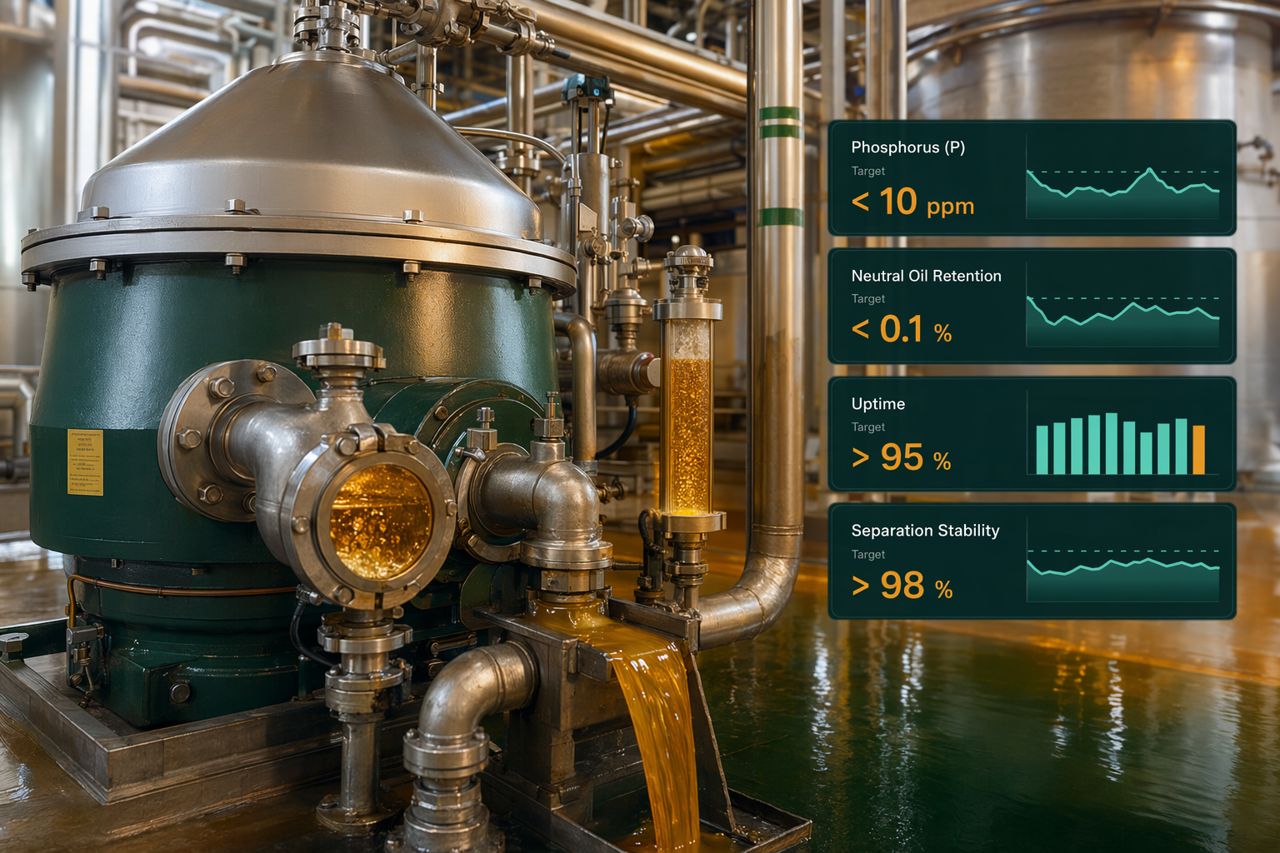
Poor separation can mask good enzyme conversion. A run may achieve strong phospholipid modification but still lose value if the centrifuge is overloaded, unstable, or producing excess oil in gums.
Laboratory and quality results
Final phosphorus, residual gums, moisture, impurities, and downstream refining indicators should be tied back to production time stamps.
The most useful quality data is not isolated in a spreadsheet. It is aligned with the exact operating window that produced the sample.
Turning logged data into better degumming decisions
Data has value only when it changes decisions. For refinery teams, the goal is not simply to collect more tags. The goal is to create a practical operating map.
Build a normal-run fingerprint
Start by defining what a successful enzymatic degumming run looks like. Capture the trends for temperature, feed flow, water addition, acid conditioning, enzyme dosing, residence time, and centrifuge performance when phosphorus targets and yield expectations are met.
This becomes the baseline fingerprint for future runs.
When a later campaign underperforms, the team can compare the current profile against the successful one and identify the first meaningful deviation.
Separate feedstock variability from process instability
Crude oil variability is real. Phosphorus load, non-hydratable phospholipids, metals, moisture, and prior handling can all shift behavior.
But without logging, feedstock variability can become the default explanation for every miss.
A strong data set helps distinguish between a difficult feed and an unstable process. If the feed changed but the operating window remained tight, enzyme program adjustment may be appropriate. If the operating window moved, the first correction may be automation or control discipline.
Protect yield while pursuing phosphorus targets
Aggressive correction can reduce phosphorus but cost neutral oil. Excessive water, harsh separation conditions, unstable emulsions, or overdosing of supporting chemicals can increase oil in gums or downstream losses.
Logged data gives the refinery a way to optimize both sides of the equation: phosphorus reduction and neutral oil retention.
The best degumming program is not the one that simply drives one number down. It is the one that helps the refinery hit specification reliably while preserving saleable oil and reducing rework.
Automation features that support enzyme-based degumming
For new installations or upgrades, several automation features deliver strong practical value.
Ratio control for additions
Acid, water, and enzyme additions should track live oil flow. Ratio control reduces manual correction and helps maintain consistent chemistry during throughput changes.
Low-flow and no-flow interlocks
Interlocks help prevent chemical or enzyme addition when oil flow stops or falls outside the defined operating range. This protects both cost and process stability.
Recipe management by feedstock
Different crude oil sources may need different setpoints. Recipe management allows operators to select approved operating conditions based on feed type, phosphorus load, or refinery mode.
Alarm limits tied to quality risk
Alarms should reflect real process risk. Temperature deviation, dosing mismatch, loss of mixer status, residence-time shortfall, and centrifuge instability should trigger action before off-spec oil moves downstream.
Batch and campaign reports
Automated reports help connect operating conditions with laboratory outcomes. These reports are especially useful during enzyme trials, supplier comparisons, and scale-up from short run to continuous campaign.
What automation partners should understand about enzymatic degumming
This topic is a strong fit for sensor, PLC, historian, and digital monitoring companies because enzymatic degumming creates a measurable control challenge.
The automation system should not treat degumming as a simple chemical injection point. It is a coordinated sequence:
- Feed characterization and flow stabilization
- Acid conditioning where required
- Controlled water addition
- Enzyme dosing at a reliable ratio
- Effective mixing
- Sufficient residence time
- Stable centrifuge separation
- Verified phosphorus and oil-loss outcomes
Each step affects the next. Good digital architecture makes those links visible.
Data expectations during a Clarivane enzyme trial
A well-run trial should generate more than a pass or fail result. Clarivane recommends that refineries capture the operating record needed to interpret performance fairly.
Useful trial data includes:
- Feed oil source and baseline phosphorus profile
- Operating rate and rate changes
- Temperature at key process points
- Acid, water, and enzyme dosing trends
- Mixer and residence-time indicators
- Centrifuge operating conditions
- Final phosphorus results by sample time
- Oil in gums or related loss indicators where available
- Any downtime, bypass, recirculation, or upset events
This information helps refine dosing strategy, identify mechanical constraints, and establish the commercial case for routine use.
The commercial payoff: fewer surprises, stronger accountability
For refinery managers, automation is not about producing attractive dashboards. It is about reducing costly uncertainty.
A good degumming data system can support:
- Faster troubleshooting when phosphorus drifts
- More stable enzyme dosing control
- Better centrifuge performance visibility
- Lower risk of neutral oil loss
- Clearer trial interpretation
- Easier operator handover between shifts
- More reliable scale-up across campaigns
- Stronger supplier accountability
Clarivane works best with refineries that want enzyme supply connected to process outcomes. Data logging gives both sides the common language to make that happen.
Practical next step
If you are evaluating enzymatic degumming or improving an existing line, bring the process data into the conversation early. The right enzyme program should be matched to your feedstock, equipment, automation capability, phosphorus target, and yield priorities.
Clarivane can support refinery teams with enzyme selection, trial planning, dosing review, and process accountability for edible oil degumming.
Request a quote through the on-site contact form to discuss your refinery line, target phosphorus range, current degumming setup, and supply requirements.