What to Record During an Enzymatic Degumming Trial
A good enzymatic degumming trial is not just a chemical test. It is a refinery performance run.
The value of the trial depends on how clearly your team can connect enzyme dosing, mixing, hydration, retention, centrifuge behavior, phosphorus reduction, oil yield, water use, and downstream stability. If the trial notes are thin, the result becomes hard to defend. If the documentation is structured, the decision becomes commercial: can this process hold target phosphorus while protecting throughput and neutral oil?
Clarivane supports edible oil refineries with enzyme solutions for degumming trials, optimization, and supply continuity. This checklist is written for refinery managers, process engineers, lab teams, and shift supervisors who need a clean record of what happened on the plant floor.
Why trial documentation matters
Enzymatic degumming can improve the economics of crude oil processing, but the process must be proven under real refinery conditions. A well-documented trial helps you answer the questions that matter:
- Did phosphorus move consistently toward the target?
- Did centrifuge separation remain stable?
- Was dosing controllable at normal plant rates?
- Did the process reduce gums without creating operational drag?
- Was neutral oil loss controlled?
- Were water, acid, caustic, and utility impacts measurable?
- Can the result be repeated on the next crude oil lot?
A refinery trial should not rely on memory, scattered lab sheets, or isolated sample results. It should create a shared record that operations, quality, maintenance, procurement, and management can review together.
1. Record the objective before the trial starts
Start with a written objective that is narrow enough to measure.
Capture the commercial aim
Examples:
- Reduce phosphorus before physical refining.
- Improve crude degumming yield versus the current acid/water route.
- Lower neutral oil loss in gums.
- Improve centrifuge stability at target throughput.
- Reduce water or chemical consumption.
- Confirm performance on a difficult crude oil source.
Define success criteria
Agree on the practical pass/fail conditions before running the trial:
- Target phosphorus range after enzymatic degumming.
- Maximum acceptable residual gums or haze.
- Acceptable centrifuge discharge behavior.
- Target flow rate or production window.
- Maximum acceptable oil loss to gums.
- Downstream impact on bleaching, deodorization, or final quality.
This prevents the trial from becoming a debate after the fact.
2. Document the crude oil feed clearly
Feed variation is one of the biggest reasons degumming trials become difficult to interpret.
Record crude oil identity
Include:
- Oil type, such as soybean, rapeseed, sunflower, corn, rice bran, or mixed feedstock.
- Tank number or lot reference.
- Supplier or origin, where available.
- Date and time of feed changeover.
- Storage temperature.
- Any blending activity before trial start.
Record baseline crude quality
Your baseline should include the values your refinery already uses to manage degumming and refining performance, such as:
- Initial phosphorus.
- Moisture.
- Free fatty acids.
- Insoluble impurities.
- Color or appearance notes.
- Previous degumming performance on the same feedstock, if available.
The key is not to create unnecessary lab burden. The key is to capture enough feed context to explain the result.
3. Record the pre-treatment conditions
Enzymatic degumming depends on the oil environment before the enzyme is added. If pre-treatment shifts during the run, the trial result may shift with it.
Capture acid and water addition
Record:
- Acid type and addition point.
- Acid dosing setting.
- Water addition point and dosing setting.
- Mixing device used before enzyme addition.
- Temperature at the addition point.
- Any visible emulsion, haze, or separation issues.
Track pH where your process uses it
If your refinery uses pH as a process-control reference, capture it consistently at the agreed sample point. Note the sampling method and timing so that readings can be compared across the trial.
4. Record enzyme dosing and handling
For an enzyme supplier for edible oil degumming, the most useful trial data often sits around dosing control and operational consistency.
Record product handling
Include:
- Enzyme product name or internal trial reference.
- Batch number.
- Storage condition before use.
- Time opened and time connected to the dosing system.
- Any dilution step, if used.
- Dilution water quality, if relevant.
Record dosing conditions
Capture:
- Dosing pump type and setting.
- Addition point.
- Oil flow rate during dosing.
- Ratio control method, if used.
- Any pump pulsation, priming, line blockage, or calibration issue.
- Actual start and stop time for enzyme addition.
Do not rely only on a target dose written in the trial plan. Record what the plant actually delivered.
5. Record mixing, retention, and temperature
Enzymes need the right contact conditions. A strong product cannot compensate for poor distribution, unstable temperature, or insufficient retention time.
Record mixing conditions
Include:
- Mixer type and location.
- Mixer speed or operating status.
- Static mixer configuration, if applicable.
- Pressure drop or flow behavior across the mixing section.
- Any vibration, foaming, entrained air, or abnormal sound.
Record retention conditions
Capture:
- Retention tank or loop used.
- Working level during the trial.
- Estimated residence time at actual flow.
- Temperature at inlet and outlet.
- Agitation status.
- Any hold-up, bypass, or recirculation event.
For refinery managers, this section often explains why a lab-positive concept may behave differently in continuous plant operation.
6. Record centrifuge behavior in plant-floor terms
Centrifuge performance is one of the most important real-world indicators in degumming.
Record machine settings
Capture the parameters your team normally uses to manage the separator:
- Bowl speed or operating mode.
- Backpressure.
- Feed rate.
- Discharge interval or discharge pattern.
- Water addition at separator, if applicable.
- Sludge handling condition.
Record observed behavior
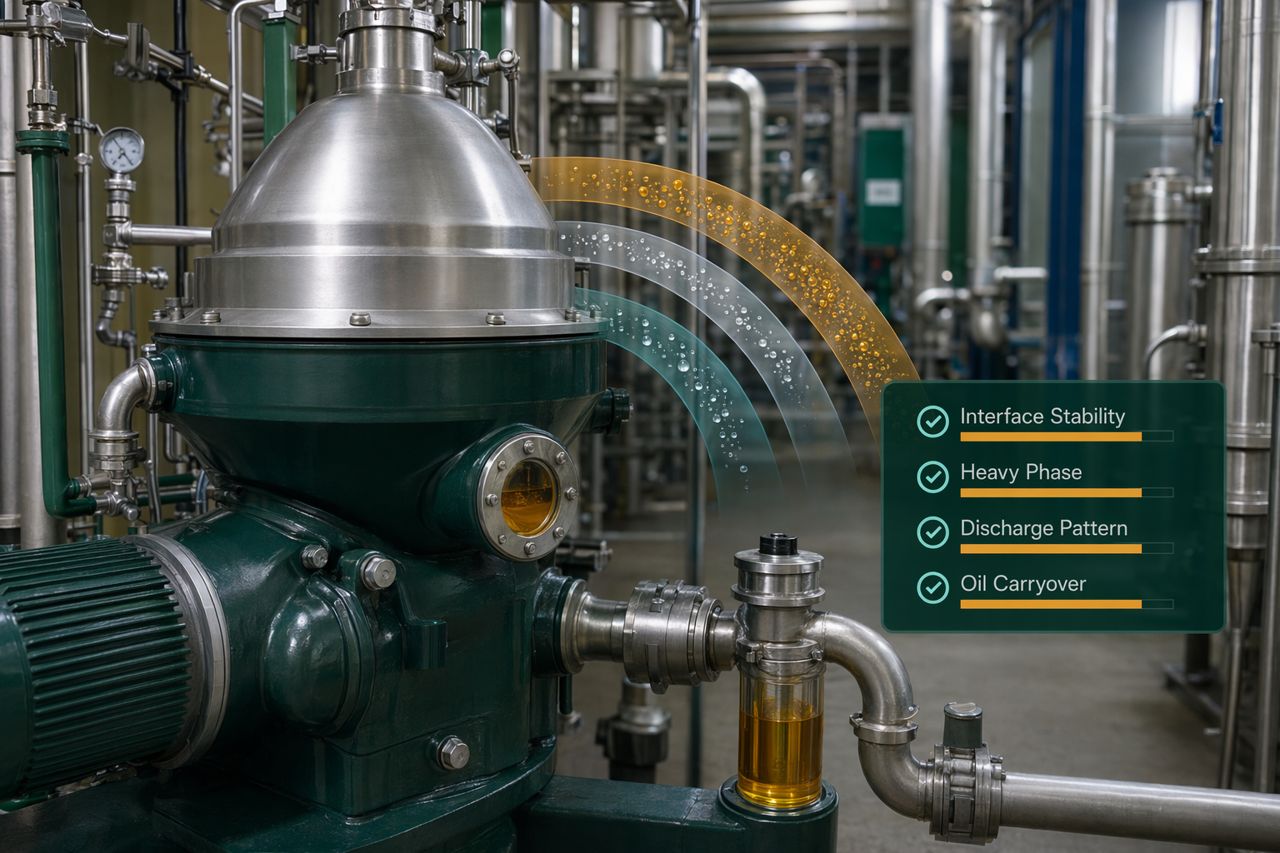
Ask the operators to log practical observations:
- Was the interface stable?
- Was the heavy phase consistent?
- Did discharge volume change?
- Did the separator require more manual attention?
- Was there oil carryover in gums?
- Was the oil phase bright, hazy, or variable?
- Did vibration, noise, or pressure instability appear?
These notes are often as valuable as lab numbers because they show whether the process is operable at scale.
7. Record sampling points and timing
Poor sampling discipline can make a good trial look uncertain.
Define sample points before the run
Common sample points may include:
- Crude oil feed before pre-treatment.
- Oil after acid and water conditioning.
- Oil after enzyme retention.
- Light phase after centrifuge.
- Heavy phase or gums.
- Downstream oil after drying, bleaching, or holding, if relevant.
Record sample timing
For every sample, capture:
- Date and time.
- Sample point.
- Operator or technician.
- Line condition at the time of sample.
- Whether the process was steady, ramping, starting, or recovering.
- Any tank switch or flow change near the sample time.
A sample without process context is only a partial record.
8. Record phosphorus results against the process timeline
Phosphorus reduction is usually a central trial KPI, but it should be reviewed with timing and flow context.
Connect results to the run condition
For each phosphorus result, note:
- Sample point.
- Sample time.
- Lab result time.
- Corresponding oil flow rate.
- Corresponding enzyme dosing status.
- Corresponding temperature and retention condition.
- Centrifuge condition at that moment.
Look for stability, not only best result
The best single result is not always the most important result. A refinery needs a process that can hold a target range under normal operating variation. Plot results against time, not just as a before-and-after table.
9. Record oil yield and neutral oil loss
Degumming success should be evaluated alongside oil recovery.
Capture mass balance inputs
Use the data your refinery can reliably obtain:
- Crude oil processed during the trial.
- Degummed oil recovered.
- Gums or heavy phase collected.
- Water and chemical inputs.
- Tank level changes.
- Sludge or waste handling notes.
Capture oil loss indicators
Record:
- Oil content in gums, where measured by your refinery.
- Heavy phase appearance.
- Separator discharge behavior.
- Any increase in emulsion formation.
- Any oil observed in drain or waste streams.
A degumming trial that lowers phosphorus but sacrifices too much neutral oil needs more optimization before scale-up.
10. Record utilities, water, and chemical impact
The commercial case often depends on more than phosphorus.
Track changes from the current process
Record trial consumption against the baseline process where possible:
- Water addition.
- Acid consumption.
- Caustic use downstream, if affected.
- Bleaching earth impact, if observed later.
- Steam or heating demand.
- Wastewater load.
- Cleaning frequency or wash requirements.
Even approximate plant data can help procurement and management understand the direction of value.
11. Record downtime, interruptions, and abnormal events
No trial is perfect. The important point is to document interruptions honestly.
Log every event that could affect interpretation
Examples:
- Feed tank switch.
- Flow reduction or production stop.
- Dosing pump interruption.
- Temperature excursion.
- Mixer stoppage.
- Separator adjustment.
- Utility pressure change.
- Lab delay.
- Operator intervention.
A transparent event log protects the integrity of the trial. It also helps Clarivane and your process team separate enzyme performance from equipment or operating issues.
12. Record operator feedback
Operators see process behavior before it appears in a report.
Ask simple, useful questions
At the end of each shift, capture:
- Was the process easier, harder, or similar to run?
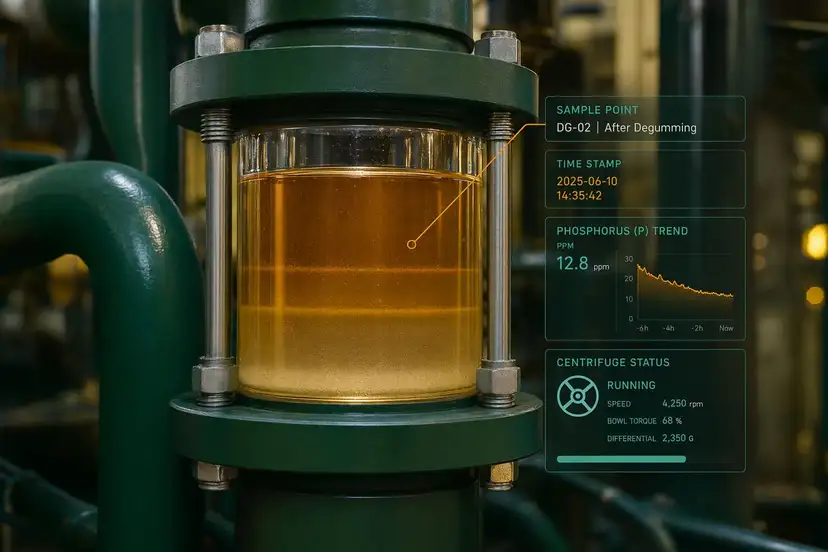
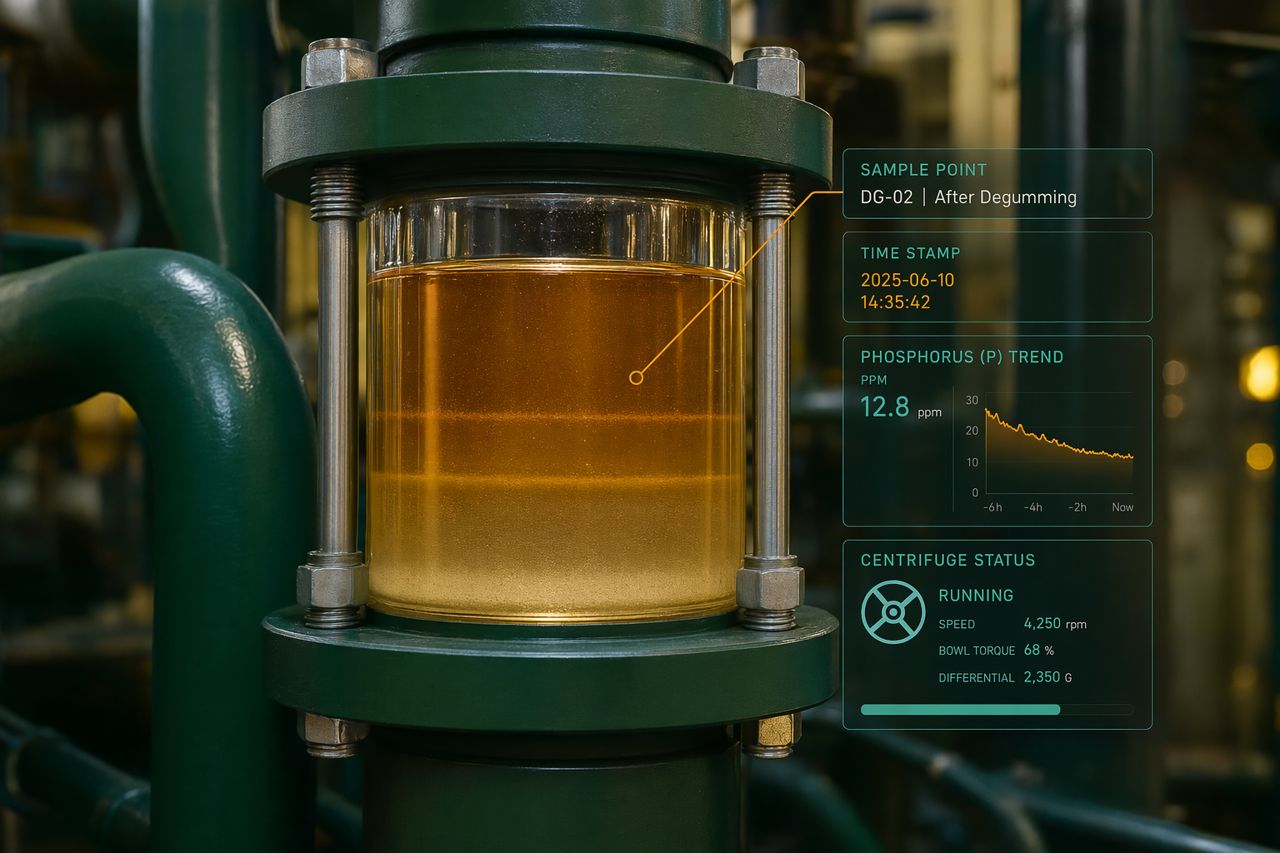
- Did the oil look different in the sight glass?
- Did the separator require adjustment?
- Were gums easier or harder to handle?
- Was there more or less foaming?
- Were there line, pump, or tank issues?
- What should be changed in the next run?
This feedback helps convert a technical result into an implementable refinery process.
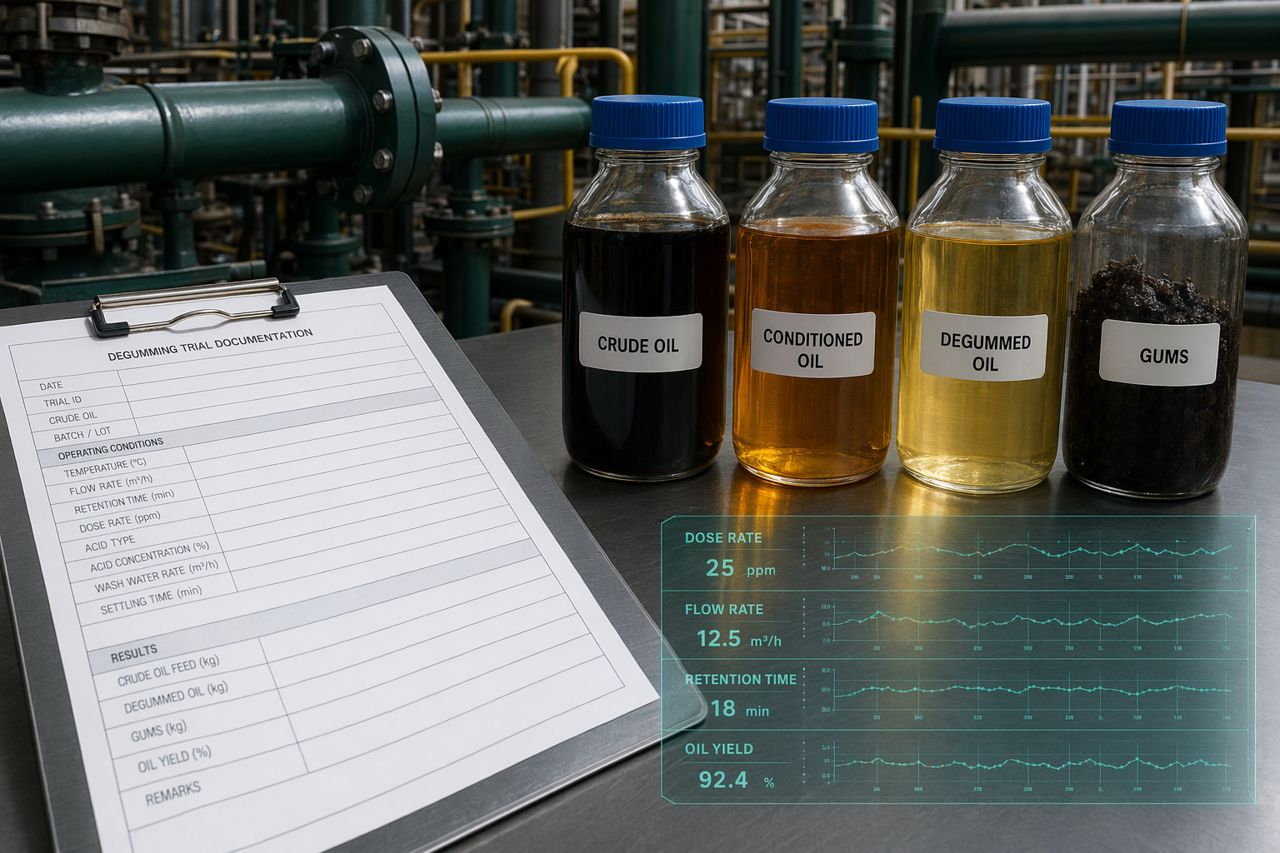
13. Build a trial summary that management can use
After the run, summarize the trial in a format that supports a decision.
Include the following sections
- Trial objective.
- Feedstock and baseline quality.
- Process configuration.
- Enzyme dosing and handling.
- Key operating conditions.
- Phosphorus results over time.
- Centrifuge behavior.
- Oil yield and loss indicators.
- Water and chemical impact.
- Abnormal events.
- Operator feedback.
- Recommended next step.
Make the recommendation practical
Examples:
- Repeat trial at the same conditions to confirm stability.
- Adjust retention time and re-test.
- Optimize dosing control at higher throughput.
- Confirm performance on a second crude oil source.
- Move to extended production trial.
- Prepare commercial supply and technical support plan.
Trial documentation checklist
Use this simplified checklist when preparing your next enzymatic degumming run:
- Objective and success criteria agreed before start.
- Feedstock identity and baseline quality recorded.
- Acid, water, temperature, and mixing conditions logged.
- Enzyme batch, handling, dilution, and dosing settings recorded.
- Actual flow rate and retention conditions tracked.
- Centrifuge settings and operator observations captured.
- Sampling points and sample times controlled.
- Phosphorus results linked to process conditions.
- Oil yield and heavy phase behavior reviewed.
- Water, chemical, and utility impacts compared to baseline.
- Interruptions and abnormal events logged.
- Operator feedback collected by shift.
- Trial summary prepared with a clear next step.
How Clarivane supports refinery trials
Clarivane supplies enzyme solutions for edible oil degumming with a focus on plant implementation, not just product shipment. We help refinery teams structure trials around the KPIs that affect operating value: phosphorus reduction, dosing stability, centrifuge behavior, neutral oil loss, water use, and repeatability.
Our role is to help your team move from trial uncertainty to a documented process decision.
Request a quote or discuss a trial plan
If you are planning an enzymatic degumming trial, Clarivane can help define the product fit, supply format, documentation needs, and commercial quote for your refinery.
Request a quote using the on-site form
Bring your oil type, target phosphorus range, current degumming route, approximate throughput, and any known centrifuge constraints. We will respond with a practical next step.